SQLite merupakan database open source yang populer digunakan dalam berbagai jenis aplikasi. SQLite sebenarnya adalah library bahasa C yang mengimplementasikan diri sebagai SQL database engine. Banyak perangkat lunak, baik seluler maupun desktop yang menggabungkan SQLite dalam sistemnya. Beberapa fitur utama dari SQLite diantaranya :
> stabilitas
> kompatibilitas yang lintas platform
> Backwards compatible
> Ukuran yang kecil : semua library kurang dari 600 Kb.
> Tersedia binari yang telah dikompilasi sebelumnya
Source code dari SQLite dikembangkan secara berkelanjutan dan pihak developer telah merencanakan untuk memberikan dukungan hingga 2050.
Instalasi SQLite sangat mudah. Bahkan pada sistem operasi seperti Mac OS X, SQLite sudah tersedia dan tinggal dijalankan. Untuk uji coba kita kali ini, kita menggunakan lingkungan sistem operasi Windows 10. Langkah instalasinya adalah sebagai berikut :
1. Siapkan file zip dari SQLite. Kita dapat mendownloadnya dari LINK INI.
2. Ekstrak file zip tersebut, idealnya pada drive C. Jadi, akses direktorinya menjadi C:\sqlite
3. Pada folder hasil ekstrak terdapat tiga file exe. Jalankan file yang bernama sqlite3.
4. Muncul layar CLI dari SQLite. Sampai di sini, kita sudah siap menjalankan perintah SQL untulk SQlite.
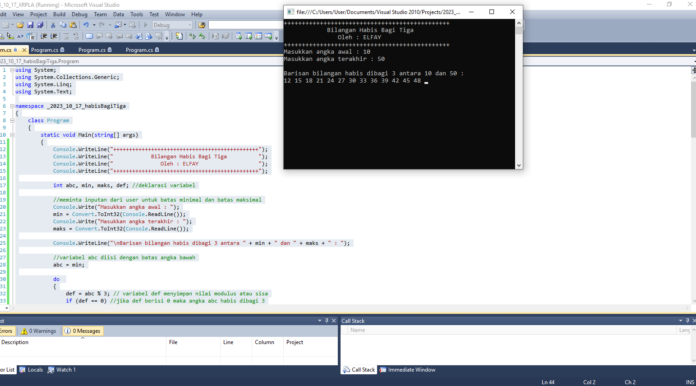
Untuk latihan looping atau perulangan kali ini, kita menggunakan studi kasus mencari angka yang habis dibagis 3 di antara dua angka tertentu. Pemecahan iterasinya menggunakan WHILE dan DO WHILE.
MENGGUNAKAN WHILE
//SOURCE CODE 0017
using System; using System.Collections.Generic; using System.Linq; using System.Text;
namespace _2023_10_17_habisBagiTiga { class Program { static void Main(string[] args) { Console.WriteLine(“++++++++++++++++++++++++++++++++++++++++++++++”); Console.WriteLine(” Bilangan Habis Bagi Tiga “); Console.WriteLine(” Oleh : ELFAY “); Console.WriteLine(“++++++++++++++++++++++++++++++++++++++++++++++”);
int abc, min, maks, def; //deklarasi variabel
//meminta inputan dari user untuk batas minimal dan batas maksimal Console.Write(“Masukkan angka awal : “); min = Convert.ToInt32(Console.ReadLine()); Console.Write(“Masukkan angka terakhir : “); maks = Convert.ToInt32(Console.ReadLine());
Console.WriteLine(“\nBarisan bilangan habis dibagi 3 antara ” + min + ” dan ” + maks + ” : “);
//variabel abc diisi dengan batas angka bawah abc = min;
while(abc <= maks) //selama abc masih kurang dari atau sama dengan maks, lakukan prosedur berikut { def = abc % 3; // variabel def menyimpan nilai modulus atau sisa if (def == 0) //jika def berisi 0 maka angka abc habis dibagi 3 { Console.Write(abc + ” “); //tulis angka abc yang habis dibagi 3 tersebut } abc++; // abc dinaikkan satu dan kembali ke WHILE untuk diperiksa apakah masih memenuhi atau tidak }
Console.ReadKey(); } } }
MENGGUNAKAN DO WHILE
using System; using System.Collections.Generic; using System.Linq; using System.Text;
namespace _2023_10_17_habisBagiTiga { class Program { static void Main(string[] args) { Console.WriteLine(“++++++++++++++++++++++++++++++++++++++++++++++”); Console.WriteLine(” Bilangan Habis Bagi Tiga “); Console.WriteLine(” Oleh : ELFAY “); Console.WriteLine(“++++++++++++++++++++++++++++++++++++++++++++++”);
int abc, min, maks, def; //deklarasi variabel
//meminta inputan dari user untuk batas minimal dan batas maksimal Console.Write(“Masukkan angka awal : “); min = Convert.ToInt32(Console.ReadLine()); Console.Write(“Masukkan angka terakhir : “); maks = Convert.ToInt32(Console.ReadLine());
Console.WriteLine(“\nBarisan bilangan habis dibagi 3 antara ” + min + ” dan ” + maks + ” : “);
//variabel abc diisi dengan batas angka bawah abc = min;
do { def = abc % 3; // variabel def menyimpan nilai modulus atau sisa if (def == 0) //jika def berisi 0 maka angka abc habis dibagi 3 { Console.Write(abc + ” “); //tulis angka abc yang habis dibagi 3 tersebut } abc++; // abc dinaikkan satu dan kembali ke WHILE untuk diperiksa apakah masih memenuhi atau tidak
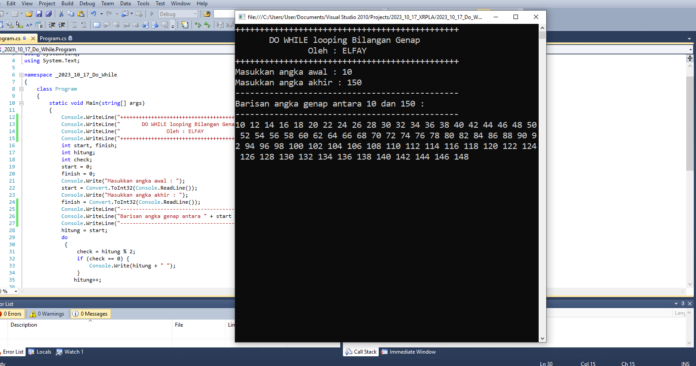
Kita dapat melakukan perulangan atau iterasi dalam pemrograman C# dengan menggunakan DO WHILE. Hampir mirip dengan WHILE, prosedur iterasi dengan DO WHILE, aksi iterasi akan terus dilakukan selama kondisinya bernilai TRUE. Bedanya, aksi pertama pada DO WHILE dilakukan sebelum pemeriksaan kondisi sedangkan pada WHILE pemeriksaan dilakukan di awal meski untuk aksi yang pertama.
//SOURCE CODE 0016
using System;
using System.Collections.Generic;
using System.Linq;
using System.Text;
namespace _2023_10_17_Do_While
{
class Program
{
static void Main(string[] args)
{
Console.WriteLine(“++++++++++++++++++++++++++++++++++++++++++++++”);
Console.WriteLine(” DO WHILE looping Bilangan Genap “);
Console.WriteLine(” Oleh : ELFAY “);
Console.WriteLine(“++++++++++++++++++++++++++++++++++++++++++++++”);
int start, finish;
int hitung;
int check;
start = 0;
finish = 0;
Console.Write(“Masukkan angka awal : “);
start = Convert.ToInt32(Console.ReadLine());
Console.Write(“Masukkan angka akhir : “);
finish = Convert.ToInt32(Console.ReadLine());
Console.WriteLine(“———————————————-“);
Console.WriteLine(“Barisan angka genap antara ” + start + ” dan ” + finish + ” : “);
Console.WriteLine(“———————————————-“);
hitung = start;
do
{
check = hitung % 2;
if (check == 0) {
Console.Write(hitung + ” “);
}
hitung++;
} while (hitung < finish);
Console.ReadKey();
}
}
}
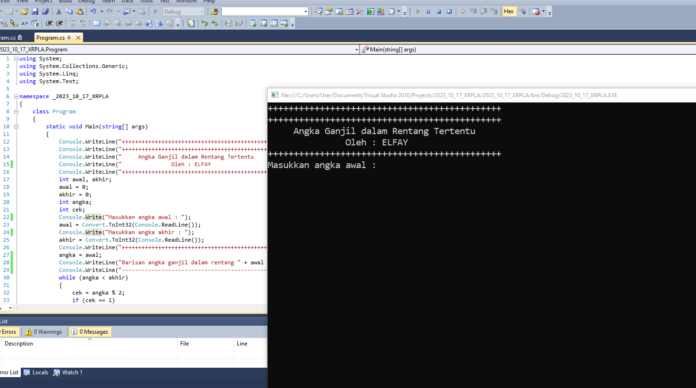
Sintaks WHILE merupakan salah satu ekspresi yang digunakan untuk looping atau perulangan dalam pemrograman C#. Untuk latihan di sini, kita menggunakan studi kasus menampilkan deretan angka ganjil dalam rentang angka tertentu yang diinputkan oleh user.
//SOURCE CODE 0015
using System; using System.Collections.Generic; using System.Linq; using System.Text;
namespace _2023_10_17_XRPLA { class Program { static void Main(string[] args) { Console.WriteLine(“+++++++++++++++++++++++++++++++++++++++++++++”); Console.WriteLine(“+++++++++++++++++++++++++++++++++++++++++++++”); Console.WriteLine(” Angka Ganjil dalam Rentang Tertentu “); Console.WriteLine(” Oleh : ELFAY “); Console.WriteLine(“+++++++++++++++++++++++++++++++++++++++++++++”); int awal, akhir; awal = 0; akhir = 0; int angka; int cek; Console.Write(“Masukkan angka awal : “); awal = Convert.ToInt32(Console.ReadLine()); Console.Write(“Masukkan angka akhir : “); akhir = Convert.ToInt32(Console.ReadLine()); Console.WriteLine(“+++++++++++++++++++++++++++++++++++++++++++++”); angka = awal; Console.WriteLine(“Barisan angka ganjil dalam rentang ” + awal + ” dan ” + akhir + ” : “); Console.WriteLine(“———————————————“); while (angka < akhir) { cek = angka % 2; if (cek == 1) { Console.Write(angka + ” “); } angka = angka + 1; } Console.ReadKey(); } } }
Studi kasus yang digunakan dalam latihan ini adalah konversi jarak dengan satuan asal pilihan km dan m, dan tujuan konversi dengan pilihan inchi dan cm. Pemecahan masalah dalam pemrograman C# menggunakan ekspresi if .. else if.
//SOURCE CODE 0014
using System;
using System.Globalization;
using System.Collections.Generic;
using System.Linq;
using System.Text;
namespace _2023_09_25_konversi_jarak
{
class Program
{
static void Main(string[] args)
{
Console.WriteLine(“======================================================================”);
Console.WriteLine(“———————————————————————-“);
Console.WriteLine(” PROGRAM KONVERSI JARAK “);
Console.WriteLine(” DEVELOPED BY : ELFAY “);
Console.WriteLine(“———————————————————————-“);
Console.WriteLine(“======================================================================”);
// km /m -> inch / cm
//variabel berat dan satuan
float jarak = 0F;
string strJarak;
string satuanInput;
string pilihMenu;
string satuanOutput = “”;
float hasilkonversi = 0F;
Console.Write(“Masukkan nilai jarak yang akan dikonversi : “);
strJarak = Console.ReadLine();
jarak = float.Parse(strJarak, CultureInfo.InvariantCulture.NumberFormat);
Console.Write(“Masukkan satuan (Pilihan : km atau m) : “);
satuanInput = Console.ReadLine();
Console.WriteLine(“———————————————————————-“);
Console.WriteLine(jarak + ” ” + satuanInput);
Console.WriteLine(“———————————————————————-“);
Console.WriteLine(“Satuan tujuan konversi (Pilih salah satu dengan mengetikkan abjad pilihan, misal : A) : “);
Console.WriteLine(“[A]. INCH “);
Console.WriteLine(“[B]. CM”);
Console.Write(“Pilihan anda : “);
pilihMenu = Console.ReadLine();
Console.WriteLine(“———————————————————————-“);
if (satuanInput == “Km” || satuanInput == “km” || satuanInput == “KM”)
{
if (pilihMenu == “A” || pilihMenu == “a”)
{
// 1 m = 39.37007874 inch, 1 km = 1000 m = 39370.07874 inch
hasilkonversi = jarak * 39370.07874F;
satuanOutput = “inch”;
}
else if (pilihMenu == “B” || pilihMenu == “b”)
{
// 1 km = 1000 m = 100000 cm
hasilkonversi = jarak * 100000F;
satuanOutput = “cm”;
}
else
{
Console.WriteLine(“———————————————————————-“);
Console.WriteLine(“MASUKAN PILIHAN TIDAK VALID”);
Console.WriteLine(“———————————————————————-“);
}
}
else if (satuanInput == “m” || satuanInput == “M”)
{
if (pilihMenu == “A” || pilihMenu == “a”)
{
// 1 m = 39.37007874 inch
hasilkonversi = jarak * 39.37007874F;
satuanOutput = “inch”;
}
else if (pilihMenu == “B” || pilihMenu == “b”)
{
// 1 m = 100 cm
hasilkonversi = jarak * 100F;
satuanOutput = “cm”;
}
else
{
Console.WriteLine(“———————————————————————-“);
Console.WriteLine(“MASUKAN PILIHAN TIDAK VALID”);
Console.WriteLine(“———————————————————————-“);
}
}
else
{
Console.WriteLine(“———————————————————————-“);
Console.WriteLine(“SATUAN TIDAK VALID”);
Console.WriteLine(“———————————————————————-“);
}
وكان مولِدُه صلى الله عليه وسلم بالشِّعبِ وهو مكانٌ معروفٌ متواترٌ عند أهلِ مكةَ. يخرُج إليه أهلُ مكةَ كلَّ عامٍ يومَ المولِدِ ويحتَفِلون بذلك أعظمَ من احْتِفالِهم بيومِ العيدِ، وذلك إلى يومِنا هذا. وقد زُرتُه وتبرَّكْتُ به عامَ حِجَّتِي سنةَ اثنتين وتسعين وسبعِمئةٍ ورأيتُ مِن بَركتِه عظيمًا. ثم كرَّرتُ زيارتَه في مُجاوَرَتِي سنةَ ثلاثٍ وعشرين وثمانِمىٔةٍ، وكان قد تُهدِّمَ فرمَّمتُه وقُرىٔ عليَّ كتابِي التعريف بالمولِد الشريفِ عليَّ وسمعه خَلقٌ لا يُحْصَون وكان يومًا مشهودًا.
Tempat kelahiran Nabi shallallahu ‘alaihi wasallam terletak di al-Syi’b (Syi’b Abi Thalib atau Syi’b Bani Hasyim atau sekarang dikenal dengan nama Syi’b Ali), sebuah tempat yang terkenal dan mutawatir bagi penduduk Mekah. Penduduk Mekah menuju ke tempat tersebut setiap tahun pada waktu kelahiran Nabi shallallahu ‘alaihi wasallam dan mengadakan perayaan Maulid yang lebih meriah dari pada perayaan hari raya. Dan kondisi itu berlangsung sampai saat ini (waktu dimana penulis mengarang kitab ini).
Aku telah mengunjungi tempat kelahiran Nabi shallallahu ‘alaihi wasallam dan mengais keberkahan dengannya pada saat aku melaksanakan ibadah haji tahun 792 H. Dan aku menyaksikan agungnya keberkahan tersebut. Aku mengunjunginya lagi pada saat kedekatanku dengan Mekah pada tahun 823 H dimana tempat kelahiran Nabi shallallahu ‘alaihi wasallam telah dibongkar, maka aku merenovasinya, dan dibacakan kepadaku kitab karyaku yang berjudul al-Ta’rif bi al-Maulid al-Syarif yang didengar oleh khalayak yang tak terhitung banyaknya. Dan hari itu menjadi hari yang masyhur. Wallahu a’lam bisshawab.
Sumber: ‘Arf al-Ta’rif bi al-Maulid al-Syarif karya al-Imam al-Hafidh al-Muqri Abu al-Khair Muhammad bin Muhammad Ibn al-Jazari, w. 833 H, Dar al-Hadits al-Kattaniyyah, hal. 23.
Oleh : KH. Bagus Ahmadi (Pondok Pesantren MIA Putra, Pacet – Moyoketen – Boyolangu Tulungagung)
وأولُ من أحدثَ ذلك الملكُ المظفَّرُ صاحبُ إربلَ، وكان يحتفل فيه احتفالاً هاىٔلا. قال سبطُ ابنِ الجوزي في مرآة الزمان: حكى لي بعضُ من حضر سماطَ المظفَّر في بعض الموالد أنه عد فيه خمسةَ آلاف رأس غنمٍ شوي، وعشرةَ آلاف دجاجة، وماىٔةَ فرس، وماىٔةَ ألف صحن حلوي. وكان يحضر عنده في المولد أعيانُ العلماء والصوفية، فيخلع عليهم ويطلق لهم العطيةَ، وكان يصرف على المولد ثلاثَماىٔة ألف دينارٍ
واستدل شيخُ الإسلام والحافظُ أبو الفضل ابنُ حجرٍ العسقلاني لكونه بدعةً حسنةً بخبر الصحيحين، أنه صلى الله عليه وسلم لما قدم المدينةَ وجد اليهودَ يصومون يومَ عاشوراءَ فسألهم فقالوا: هذا يومٌ أغرق اللهُ فيه فرعونَ ونجَّى موسى فنحن نصومه شكرًا لله تعالى، فقال صلى الله عليه وسلم: أنا أحقُّ بموسى منكم، فصامه وأمرَ بصيامه
قال -أعني شيخُ الإسلام: فيُستفاد منه فضلُ الشكر لله تعالى بأنواعِ العبادات على ما منَّ به في يوم معين من إسداءِ نعمة أو دفع نقمة ويُعاد ذلك في نظير ذلك اليوم من كل سنة. وأيُّ نعمةٍ أعظم من بُروزِ هذا النبيِّ صلى الله عليه وسلم نبيِّ الرحمة في ذلك اليومِ
Orang pertama yang mengadakan perayaan Maulid Nabi shallallahu ‘alaihi wasallam adalah raja al-Mudhaffar (Mudhaffar al-Din Abu Sa’id Kukburi bin Zain al-Din Ali (549-630 H), penguasa Arbil Irak. Ia mengadakan perayaan Maulid Nabi shallallahu ‘alaihi wasallam dengan perayaan yang mencengangkan. Cucu Ibn al-Jauzi (Syaikh Syams al-Din Abu al-Mudhaffar Yusuf bin Qazughli bin Abdullah (581-654 H) dalam kitab Mir-ah al-Zaman fi Tawarikh al-A’yan berkata : “Sebagian orang yang hadir dalam jamuan makannya raja al-Mudhaffar dalam sebagian perayaan Maulid Nabi shallallahu ‘alaihi wasallam menceritakan kepadaku bahwa jumlah hidangannya adalah lima ribu kepala kambing bakar, sepuluh ribu ekor ayam, seratus ekor kuda, dan seratus piring manisan. Beliau menghadirkan para pemuka ulama dan tokoh sufi. Beliau menyerahkan berbagai pemberian kepada mereka dan mensedekahkan sebesar tiga ratus ribu dinar dalam acara Maulid tersebut.
Syaikh al-Islam al-Hafidh Abu al-Fadl Ibn Hajar al-‘Asqalani (773-852 H) mengetengahkan dalil tentang keberadaan Maulid Nabi shallallahu ‘alaihi yang dihukumi sebagai bid’ah hasanah dengan dasar hadits shahihain (riwayat al-Bukhari dan Muslim), bahwa Rasulullah shallallahu ‘alaihi wasallam ketika tiba di Madinah menjumpai orang-orang Yahudi menjalankan puasa hari ‘Asyura, Beliau bertanya kepada mereka, dan mereka menjawab: “Hari ini adalah hari dimana Allah ta’ala menenggelamkan Fir’aun dan menyelamatkannabi Musa, kami berpuasa sebagai ungkapan rasa syukur kepada Allah ta’ala.” Nabi shalallahu alaihi wasallam lantas berkata: “Aku lebih mempunyai terhadap nabi Musa daripada kalian.” Lalu Nabi shallallahu ‘alaihi wasallam berpuasa ‘Asyura dan menyuruh para sahabat untuk berpuasa.
Syaikh al-Islam Ibn Hajar al-‘Asqalani berkata: “Dari hadits diatas dapat diambil faedah tentang keutamaan bersyukur kepada Allah ta’ala dengan melaksanakan berbagai macam ibadah atas anugerah yang telah dilimpahkan-Nya pada hari tertentu, baik berupa pemberian kenikmatan maupun terhindar dari bencana, dan bisa diulang pada hari yang sama setiap tahunnya. Namun mana yang lebih agung daripada kelahiran Sang Nabi ini shallallahu ‘alaihi wasallam, yakni Nabi pembawa rahmat, pada hari itu.
Wallahu a’lam bisshawab.
Sumber: Syarh al-Maulid al-Nabawi, Al-Kaukab al-Anwar ‘ala ‘Iqd al-Jauhar fi Maulid al-Nabi al-Azhar karya Mufti madzhab Syafi’i di Madinah al-‘Allamah Sayyid Ja’far bin Isma’il bin Zain al-‘Abidin bin Muhammad al-Hadi bin Zain bin Ja’far bin Hasan al-Barzanji (1250-1317 H), cicit dari pengarang kitab Maulid al-Barzanji yaitu al-‘Allamah Sayyid Ja’far bin Hasan bin Abdul Karim al-Barzanji (1128-1177 H), Markaz Ibn ‘Aththar li al-Turats, hal. 17-18.
Oleh : KH. Bagus Ahmadi (Pondok Pesantren MIA Putra – Pacet, Moyoketen, Boyolangu, Tulungagung)
What’s possible in a week? If you dedicated seven days to the achievement of one goal, how ambitious could you make this goal? These were the questions that the multilingual friends Katy and Sara posed themselves when they determined to learn English in one week, to prove that it can be done and anyone can do it with the right methods.
They would attempt to liberate themselves from the distractions and responsibilities of modern-day life in order to cram eight hours of study time and I was observing some of the world’s most capable language learners at work.
The language learning expert: Sara
The friends set themselves the challenge of learning a language in a week in order to stretch themselves, and then it was a question of choosing which language to learn. English presented itself as a natural option; there are nigh on 300,000 English speakers in Germany’s capital, and the areas are dotted with stores adorned with signs in English.
“Truly understanding one’s environment requires one to first understand English”
The first operational step in the friends learning process was to decorate the entire apartment with sticky notes. This had an almost ceremonial touch to it as the friends delved into dictionaries and proceeded to label everything with its corresponding English name.
Within the space of about an hour it was impossible to carry out any menial task, be it making a coffee or flicking off a light switch, without first being presented with at least three different words related to this action.
Sara learning in the park
The importance of the other twin’s presence became immediately apparent as Katy and Sara delegated responsibilities for rooms to decorate with sticky notes. This simple task was augmented by continuous little tests that they would spring on one another, and the fact that they split up their day slightly differently and studied different topics meant that each twin became a source of knowledge for the other.
The most extraordinary moment came towards the end of the week!
The friends simply switched their everyday conversations to English, asking one another if they wanted tea or coffee, were ready to cook dinner or when they were going to leave the house.
Katy and Sara had numerous micro-challenges throughout the week. On the first day they were visited by a English friend who greeted them in English and complimented them on how quickly they’d picked up their first words and phrases.
They then learned the names of fruits and the numbers from one to a billion so that they could visit the English market (although they refrained from purchasing nine hundred thousand kumquats). Displaying their haul after their first functional exchange in English, they beamed with pride and a palpable sense of accomplishment before marching back home to study further.
Katy playing audio lessons
On our second visit to the brother’s apartment 24 hours into the week, we found them sampling dozens of different kinds of English snacks.
Like kids staring at the backs of cereal packs before heading to school, the nutritional information and various special offers and competitions on the packaging were analysed during snack breaks.
There was no moment of complete removal from the language learning process during the eight hours that the friends had allotted to it.
They were constantly using their existing knowledge to support the ever-growing knowledge of English, this being the root of their success.
“you will likely come across words that share common origins with your native tongue”
The friends spent a lot of time engrossed in books or on their computers and apps, flicking and swiping their way through exercises eagerly, but at other times they were to be found searching busily for English radio stations and write-ups of English football games on the web.
There is no definitive method to learn a language fluently
All too often, people enter their weekly language class to converse with their teacher, but then barely have any contact with other speakers and that’s not enough.
The old saying that we can solve problems more effectively when we sleep on it may be especially true if the problem we’re trying to solve is learning a new language.
Motivated Katy out to the library
Researchers from two Swiss universities wanted to know if they could enhance the learning of words from a foreign language by exposing people to the words during non-rapid eye movement sleep the deep, dreamless sleep period that most of us experience during the first few hours of the night.
To find out, they gathered two groups of study participants, all of whom were native German speakers, and gave them a series of Dutch-to-German word pairs to learn at 10 pm. One group was then instructed to get some sleep, while the other group was kept awake.For the next few hours both groups listened to an audio playback of the word pairs they’d already been exposed to and some they hadn’t yet heard.
The researchers then re-gathered both groups at 2 am and gave them a test of the Dutch words to uncover any differences in learning. And indeed there was a difference:
“The group that listened to the words during sleep did better at recalling the words they’d heard”
The simple yet potent trick the researchers employed is known as verbal cueing, and this isn’t the first claim made for its success while sleeping. But what makes this study different is that it puts a finer point on the conditions necessary for this trick to actually work namely, it only works when we’ve already been exposed to the verbal cues before we sleep.
The researchers added a techie dimension by conducting electroencephalographic (EEG)recordings of the sleeping participants brains to track neural electrical activity during the learning period.
They found that learning the foreign words overlapped with the appearance of theta brain waves, an intriguing result since theta is the brain wave state often associated with heightened learning while awake (usually we’re in either the high-frequency, high-alertness alpha or beta states while awake, but it’s thought possible to induce theta state slower in frequency than alpha and beta through concentration techniques).
What’s possible in a week? If you dedicated seven days to the achievement of one goal, how ambitious could you make this goal? These were the questions that the multilingual friends Katy and Sara posed themselves when they determined to learn English in one week, to prove that it can be done and anyone can do it with the right methods.
They would attempt to liberate themselves from the distractions and responsibilities of modern-day life in order to cram eight hours of study time and I was observing some of the world’s most capable language learners at work.
The language learning expert: Sara
The friends set themselves the challenge of learning a language in a week in order to stretch themselves, and then it was a question of choosing which language to learn. English presented itself as a natural option; there are nigh on 300,000 English speakers in Germany’s capital, and the areas are dotted with stores adorned with signs in English.
“Truly understanding one’s environment requires one to first understand English”
The first operational step in the friends learning process was to decorate the entire apartment with sticky notes. This had an almost ceremonial touch to it as the friends delved into dictionaries and proceeded to label everything with its corresponding English name.
Within the space of about an hour it was impossible to carry out any menial task, be it making a coffee or flicking off a light switch, without first being presented with at least three different words related to this action.
Sara learning in the park
The importance of the other twin’s presence became immediately apparent as Katy and Sara delegated responsibilities for rooms to decorate with sticky notes. This simple task was augmented by continuous little tests that they would spring on one another, and the fact that they split up their day slightly differently and studied different topics meant that each twin became a source of knowledge for the other.
The most extraordinary moment came towards the end of the week!
The friends simply switched their everyday conversations to English, asking one another if they wanted tea or coffee, were ready to cook dinner or when they were going to leave the house.
Katy and Sara had numerous micro-challenges throughout the week. On the first day they were visited by a English friend who greeted them in English and complimented them on how quickly they’d picked up their first words and phrases.
They then learned the names of fruits and the numbers from one to a billion so that they could visit the English market (although they refrained from purchasing nine hundred thousand kumquats). Displaying their haul after their first functional exchange in English, they beamed with pride and a palpable sense of accomplishment before marching back home to study further.
Katy playing audio lessons
On our second visit to the brother’s apartment 24 hours into the week, we found them sampling dozens of different kinds of English snacks.
Like kids staring at the backs of cereal packs before heading to school, the nutritional information and various special offers and competitions on the packaging were analysed during snack breaks.
There was no moment of complete removal from the language learning process during the eight hours that the friends had allotted to it.
They were constantly using their existing knowledge to support the ever-growing knowledge of English, this being the root of their success.
“you will likely come across words that share common origins with your native tongue”
The friends spent a lot of time engrossed in books or on their computers and apps, flicking and swiping their way through exercises eagerly, but at other times they were to be found searching busily for English radio stations and write-ups of English football games on the web.
There is no definitive method to learn a language fluently
All too often, people enter their weekly language class to converse with their teacher, but then barely have any contact with other speakers and that’s not enough.
The old saying that we can solve problems more effectively when we sleep on it may be especially true if the problem we’re trying to solve is learning a new language.
Motivated Katy out to the library
Researchers from two Swiss universities wanted to know if they could enhance the learning of words from a foreign language by exposing people to the words during non-rapid eye movement sleep the deep, dreamless sleep period that most of us experience during the first few hours of the night.
To find out, they gathered two groups of study participants, all of whom were native German speakers, and gave them a series of Dutch-to-German word pairs to learn at 10 pm. One group was then instructed to get some sleep, while the other group was kept awake.For the next few hours both groups listened to an audio playback of the word pairs they’d already been exposed to and some they hadn’t yet heard.
The researchers then re-gathered both groups at 2 am and gave them a test of the Dutch words to uncover any differences in learning. And indeed there was a difference:
“The group that listened to the words during sleep did better at recalling the words they’d heard”
The simple yet potent trick the researchers employed is known as verbal cueing, and this isn’t the first claim made for its success while sleeping. But what makes this study different is that it puts a finer point on the conditions necessary for this trick to actually work namely, it only works when we’ve already been exposed to the verbal cues before we sleep.
The researchers added a techie dimension by conducting electroencephalographic (EEG)recordings of the sleeping participants brains to track neural electrical activity during the learning period.
They found that learning the foreign words overlapped with the appearance of theta brain waves, an intriguing result since theta is the brain wave state often associated with heightened learning while awake (usually we’re in either the high-frequency, high-alertness alpha or beta states while awake, but it’s thought possible to induce theta state slower in frequency than alpha and beta through concentration techniques).
What’s possible in a week? If you dedicated seven days to the achievement of one goal, how ambitious could you make this goal? These were the questions that the multilingual friends Katy and Sara posed themselves when they determined to learn English in one week, to prove that it can be done and anyone can do it with the right methods.
They would attempt to liberate themselves from the distractions and responsibilities of modern-day life in order to cram eight hours of study time and I was observing some of the world’s most capable language learners at work.
The language learning expert: Sara
The friends set themselves the challenge of learning a language in a week in order to stretch themselves, and then it was a question of choosing which language to learn. English presented itself as a natural option; there are nigh on 300,000 English speakers in Germany’s capital, and the areas are dotted with stores adorned with signs in English.
“Truly understanding one’s environment requires one to first understand English”
The first operational step in the friends learning process was to decorate the entire apartment with sticky notes. This had an almost ceremonial touch to it as the friends delved into dictionaries and proceeded to label everything with its corresponding English name.
Within the space of about an hour it was impossible to carry out any menial task, be it making a coffee or flicking off a light switch, without first being presented with at least three different words related to this action.
Sara learning in the park
The importance of the other twin’s presence became immediately apparent as Katy and Sara delegated responsibilities for rooms to decorate with sticky notes. This simple task was augmented by continuous little tests that they would spring on one another, and the fact that they split up their day slightly differently and studied different topics meant that each twin became a source of knowledge for the other.
The most extraordinary moment came towards the end of the week!
The friends simply switched their everyday conversations to English, asking one another if they wanted tea or coffee, were ready to cook dinner or when they were going to leave the house.
Katy and Sara had numerous micro-challenges throughout the week. On the first day they were visited by a English friend who greeted them in English and complimented them on how quickly they’d picked up their first words and phrases.
They then learned the names of fruits and the numbers from one to a billion so that they could visit the English market (although they refrained from purchasing nine hundred thousand kumquats). Displaying their haul after their first functional exchange in English, they beamed with pride and a palpable sense of accomplishment before marching back home to study further.
Katy playing audio lessons
On our second visit to the brother’s apartment 24 hours into the week, we found them sampling dozens of different kinds of English snacks.
Like kids staring at the backs of cereal packs before heading to school, the nutritional information and various special offers and competitions on the packaging were analysed during snack breaks.
There was no moment of complete removal from the language learning process during the eight hours that the friends had allotted to it.
They were constantly using their existing knowledge to support the ever-growing knowledge of English, this being the root of their success.
“you will likely come across words that share common origins with your native tongue”
The friends spent a lot of time engrossed in books or on their computers and apps, flicking and swiping their way through exercises eagerly, but at other times they were to be found searching busily for English radio stations and write-ups of English football games on the web.
There is no definitive method to learn a language fluently
All too often, people enter their weekly language class to converse with their teacher, but then barely have any contact with other speakers and that’s not enough.
The old saying that we can solve problems more effectively when we sleep on it may be especially true if the problem we’re trying to solve is learning a new language.
Motivated Katy out to the library
Researchers from two Swiss universities wanted to know if they could enhance the learning of words from a foreign language by exposing people to the words during non-rapid eye movement sleep the deep, dreamless sleep period that most of us experience during the first few hours of the night.
To find out, they gathered two groups of study participants, all of whom were native German speakers, and gave them a series of Dutch-to-German word pairs to learn at 10 pm. One group was then instructed to get some sleep, while the other group was kept awake.For the next few hours both groups listened to an audio playback of the word pairs they’d already been exposed to and some they hadn’t yet heard.
The researchers then re-gathered both groups at 2 am and gave them a test of the Dutch words to uncover any differences in learning. And indeed there was a difference:
“The group that listened to the words during sleep did better at recalling the words they’d heard”
The simple yet potent trick the researchers employed is known as verbal cueing, and this isn’t the first claim made for its success while sleeping. But what makes this study different is that it puts a finer point on the conditions necessary for this trick to actually work namely, it only works when we’ve already been exposed to the verbal cues before we sleep.
The researchers added a techie dimension by conducting electroencephalographic (EEG)recordings of the sleeping participants brains to track neural electrical activity during the learning period.
They found that learning the foreign words overlapped with the appearance of theta brain waves, an intriguing result since theta is the brain wave state often associated with heightened learning while awake (usually we’re in either the high-frequency, high-alertness alpha or beta states while awake, but it’s thought possible to induce theta state slower in frequency than alpha and beta through concentration techniques).